
You can find here a brief overview of my main research projects.


Caching Behaviour
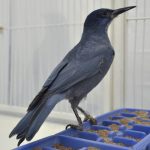
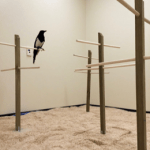
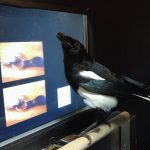
Food-storing (i.e. caching) animals rely on cached food to survive when resources in the environment are low. Caching individuals must remember the location of their caches and limit the risk of losing their food caches by changing their caching behaviour in presence of potential thieves (i.e. pilferers). Corvids (e.g., magpies, jays, crows) are a group of bird species known to change their caching behaviour in the presence of others to prevent others to steal their stored food. During my PhD, I compared the caching behaviour of solitary Clark’s nutcrackers and highly-social pinyon jays, two corvid species that rely heavily on cached pine seeds to survive during winter. I evaluated the social cues and social information corvids use to modify their caching behaviour.
Publications:
1. Conspecific presence, but not pilferage, influences pinyon jays’ (Gymnorhinus cyanocephalus) caching behavior.
2. Social information used to elicit cache protection differs between pinyon jays and Clark’s nutcrackers.
3. Pinyon jays (Gymnorhinus cyanocephalus) and Clark’s nutcrackers (Nucifraga columbiana) can discriminate between pilfering and non-pilfering conspecifics, but not between heterospecifics.
Response Inhibition (Inhibitory Control)
Response inhibition is the ability to restrict a prepotent response in favour of a more rewarding one. It is thought to be an essential component for other more complex cognitive abilities (e.g., future planning, problem-solving). This ability is relatively easy to test, and many tasks have been developed to evaluate it. As a side project of my PhD and during my first postdoctoral position, I evaluated whether different tasks purporting to measure response inhibition were indeed all assessing the same cognitive ability. I then assessed whether personality (more specifically neophobia, aggression), diet (more specifically glucose), and early-life social group size could explain individual differences in response inhibition. Finally, I wondered if individuals could learn to inhibit their responses.
Publications:
1. Inhibition in Clark’s nutcrackers (Nucifraga columbiana): results of a detour-reaching test.
2. Neophobia does not account for motoric self-regulation as measured during the detour-reaching cylinder task.
3. Individual performance across motoric self-regulation tasks are not correlated in pet dogs.
4. Motoric self-regulation by sled dogs and pet dogs and the acute effect of carbohydrate source in sled dogs.
5. Early-life group size influences response inhibition, but not the learning of it, in Japanese quails.
6. To peck or not to peck: The influence of early-life social environment on response inhibition and impulsive aggression in Japanese quails.
7 & 8. Unpacking response inhibition in animals.
Responses to Novelty
How individuals respond to novelty often determine how they interact with their environment. Responses to novelty are usually assessed through neophobia (i.e., fear of novelty) and exploration/neophilia (i.e., interest to interact with novelty). These responses are usually repeatable over time and across contexts, which in such case constitute a personality trait. During my PhD, I compared four corvids species’ responses to novelty to determine whether, and if so why, they differed.
Publications:
1. Individual exploratory responses are not repeatable across time or context for four species of food-storing corvid.
2. A large-scale study across the avian clade identifies ecological drivers of neophobia.
Abstract Concept Learning
Comparing the ability to learn abstract concepts, such as same/different, smaller/bigger, more/less, between species allow us to understand how complex cognitive abilities evolve. As a side project for my PhD, I evaluated the learning rates between four corvid species.
Publications:
1. Corvids outperform pigeons and primates in learning a basic concept.
2. Abstract-concept learning in two species of New World corvids, pinyon jays (Gymnorhinus cyanocephalus) and California scrub jays (Aphelocoma californica).
Habitat Selection
Habitat selection is a critical step in an animal’s life because it strongly influences its probability of survival and reproductive success. During my MSc, I evaluated the fitness consequences of habitat selection in response to nest predation risk and to forest harvesting by migratory forest songbirds.
Publications:
1. ENSO, nest predation risk, food abundance, and male status fail to explain annual variations in the apparent survival rate of a migratory songbird.
2. Linking songbird nest predation to seedling density: sugar maple masting as a resource pulse in a forest food web.
3. Do female songbirds avoid a mammalian nest predator when selecting their nest site?
Behavioural Adaptations to Urbanization
Urbanization is one of the fastest forms of environmental change. Animals vary in their ability to cope with urban environments. Through students’ supervision, we evaluated the behavioural adaptations to human-altered environments. Students compared the reproductive and foraging behaviours, activity patterns, and overall fitness, between urban and rural songbirds.
 Dr. Alizée Vernouillet